Exit Wounds 

Two boys smiling and waving in front of makeshift shelters in a refugee camp, with smoke rising in the background and mountains in the distance.

Exit Wounds is an independent journalism and field research initiative covering conflict, displacement, and humanitarian issues across the Middle East and Eastern Europe. Through firsthand reporting, interviews, and documentary photography, Exit Wounds examines how people navigate crisis, war, and the rebuilding of everyday life after conflict.

A refugee camp with tents and temporary shelters, including UNHCR tents, on a dusty ground with some smoke in the background.

Dispatch One — The Return Dilemma

In Lebanon’s Beqaa Valley, the war in Syria feels both distant and immediate. A decade after displacement, thousands of Syrians remain caught between permanence and return - raising families in tents while the idea of “home” grows abstract. With Lebanon’s economic collapse deepening and the UN promoting a voluntary return plan, refugees now face a moral and practical question: stay in exile or return to a country reborn under a new flag.

The Syrian Arab Republic no longer exists as it once did. In its place, a new government backed by regional powers is attempting to project stability - reopening schools, restoring utilities, and urging citizens to “come home.”

For those still in Lebanon, this message has found its way into conversation. The people I met spoke of this new Syria not through politics, but through the language of necessity. Their belief, or even mild trust, in this government gives it quiet legitimacy.

For Damascus, every returning family is proof that peace has returned; for those who stay, silence is its own form of resistance.

Inside Jurahiya Camp, between Bar Elias and Al Marj, I spoke with young Syrians, teachers, and families weighing that choice. Some trust the new government and plan to go back once homes are rebuilt. Others say they have nothing left to return to, no roofs, no work, and no certainty that this peace is real.

“Syria is not ready for us to go back to.” - Faraj, 23, from Aleppo

“Many Syrians still have hope. We see a real future.” - Rania, teacher at Jusoor Center

Each conversation revealed a different version of survival, shaped less by politics than by exhaustion. Between lessons, odd jobs, and the daily act of waiting, these refugees are redefining what it means to belong. Their quiet decisions - to stay, to leave, or to believe - will decide whether the new Syrian state becomes reality, or remains a promise made to the displaced.

Jurahiya Camp, West Beqaa Valley, Lebanon · October 2025

Kamil Qadri

A man with black hair, sunglasses, and casual clothing stands holding a camera in front of a burning area with smoke and debris, and makeshift structures in the background.

Kamil Qadri is a freelance journalist and field researcher covering conflict, displacement, and humanitarian issues. He founded Exit Wounds to document how people experience crisis, navigate exile, and rebuild their lives across the Middle East, North Africa, and Eastern Europe.

His work combines firsthand interviews, documentary photography, and research to connect civilian experiences with the political decisions and humanitarian conditions shaping them. He focuses on displaced youth, refugee return, and the lasting consequences of conflict beyond the fighting.

His field reporting includes Syrian refugees facing return pressures and declining aid in Lebanon’s Beqaa Valley; displaced Ukrainian youth navigating education and integration in Bucharest; and protest movements and political mobilization in Athens.

Qadri’s approach emphasizes careful sourcing, informed consent, and respect for the people whose experiences inform his reporting. His research on Syrian refugee return, drawing on interviews in the Beqaa Valley, has been published by the MEA Institute for Strategic Studies.

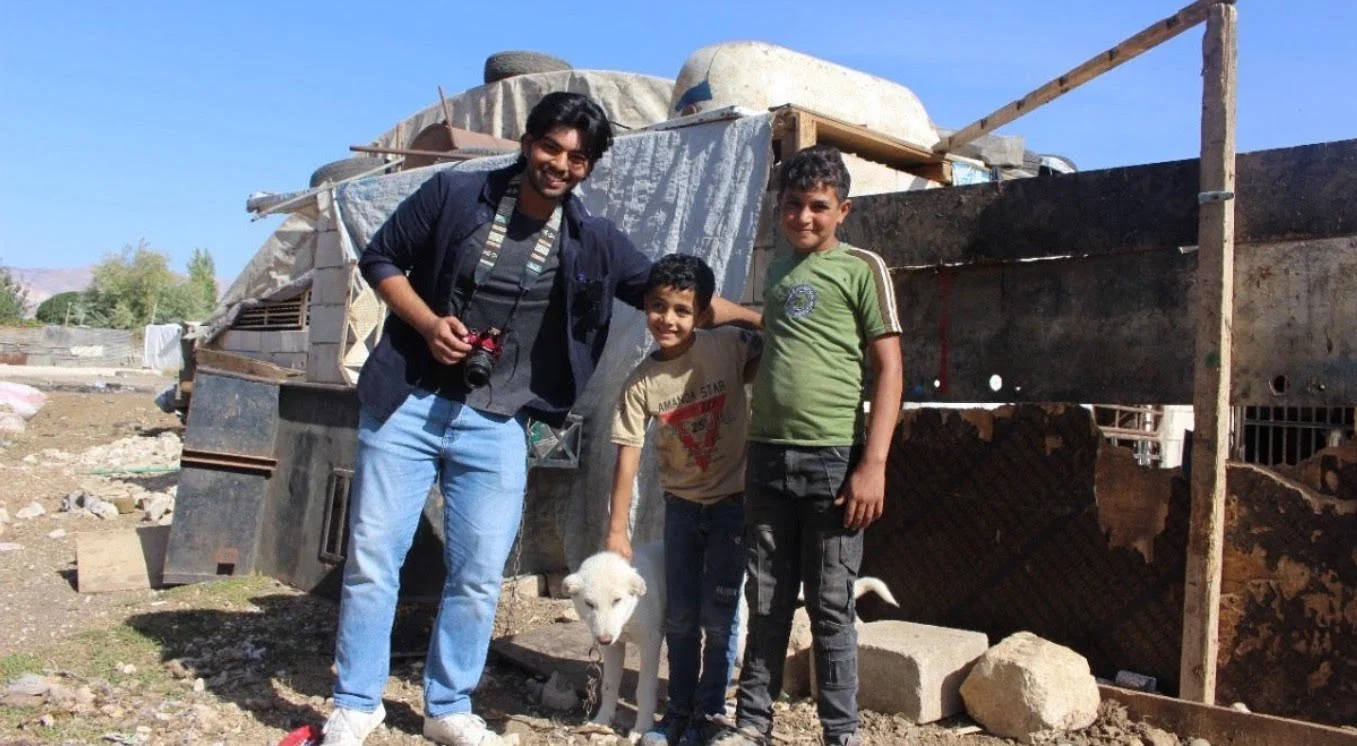
Qadri reporting in Lebanon’s Beqaa Valley

Dispatch Two -“Ukraine’s Lost Generation”

Bucharest Sector IV, Romania - December 15, 2025

An on-the-ground look at how prolonged displacement is complicating post-war return and recovery for Ukraine. Full story currently being pitched to international outlets.

‍ ‍

Nearly four years into the war, young Ukrainians in Bucharest are building lives they once expected to be temporary. Teenagers who fled in their early teens are approaching adulthood, making decisions about education, work, and relationships that may take them further from returning home.

At the Jesuit Refugee Service (JRS) in Romania, education and language programs help displaced children navigate those years. Ukrainian teachers support children through kindergarten activities, language classes, and music lessons.

Mariia, 20, from Odesa, teaches a classroom of 25 children while pursuing an international relations degree online through her university in Ukraine. I sat down with her in Bucharest to discuss life in prolonged displacement.

“Here I volunteer—I help with translations, documents, and I teach English to children.”

Her education remains rooted in Ukraine, but her daily responsibilities are in Romania. Asked about return, Mariia says she does not think everyone who grew up abroad will go back. New friendships, languages, and routines have given young people reasons to imagine their futures elsewhere.

Building a life in Romania, however, does not mean feeling fully accepted.

Hanna, 16, also from Odesa, has lived in Romania since March 2022. She says people in Bucharest have told her to “go back to Ukraine.”

“There is bullying,” Hanna tells me. “Teachers say bad things. Ukrainian children are sometimes separated in class.”

Describing her younger sister’s public elementary school, Hanna says Romanian children sit toward the front while Ukrainian students sit at the back.

Mariia also describes hostility, including reports of damage to Ukrainian cars and unequal treatment in the rental market. “Sometimes one room costs twice as much just because you are Ukrainian,” she says.

She believes some resentment comes from a perception that Ukrainians receive advantages unavailable to Romanians.

“They don’t understand that we also had normal lives in Ukraine.”

These accounts complicate the idea that remaining abroad is a straightforward choice. Young people can face exclusion in the same places where they are forming friendships, gaining qualifications, and beginning to establish independent lives.

Apartment blocks in Sector IV, Bucharest, now home to many Ukrainian refugees.

A Ukranian flag hangs behind the Jesuit Refugee Service desk, Bucharest

For families who imagined exile as temporary, those attachments raise difficult questions. Returning would mean more than crossing a border. It could mean leaving behind the places where their children have grown up.

Ukraine’s reconstruction will depend on people as well as infrastructure: teachers, professionals, and young adults whose skills will help sustain recovery. Some are now studying and working abroad, building ties that could make return a more complicated decision.

Mariia belongs to that generation. Her education is Ukrainian. Her daily life is Romanian. Her work already supports other displaced families.

For Hanna, return remains tied to belonging rather than certainty. “Home is home,” she says, while acknowledging that many people will not go back.

Others are more direct. Alena, 18, from Kherson, arrived in Romania in April 2022 after leaving Ukraine at fourteen. She has friends, a boyfriend, and plans to study music. She is learning Japanese and wants to move to Japan.

“My adolescence happened here,” she says.

Whether young Ukrainians return will depend on safety and opportunity, but also on what returning would require them to leave behind. The longer displacement continues, the more those decisions involve lives already taking shape elsewhere.

A donation box for refugees sits Infront of a calendar

abcdef

Dispatch: Athens Moves as One - Inside the November 17 Polytechnic March

Riot police hold a defensive line on Alexandras Avenue as thousands of protesters pass by

ATHENS— The air was already heavy on Alexandras Avenue by early evening, long before the march reached the U.S. Embassy. What starts every year as a commemoration of the 1973 Polytechnic uprising has become something more layered: a test of political mood, a measure of how Greece sees its alliances, and a glimpse into which way the city’s younger blocs are leaning.
More than an hour before the front banners arrived, riot police units took up positions along the perimeter streets leading to the embassy.
They stood with the practiced stillness of a force that has done this dozens of times, knowing that the march always stops here,  and that everything after depends on the mood of the crowd.
By the time the first clusters of protesters reached the avenue, the crowd had thickened into thousands. Older men who lived through past marches walked alongside students who weren’t born when the first antiauthoritarian blocs took shape. Metal barricades rattled under the weight of people leaning over them for a clearer view.
The march moved in formations, not as a loose flow but as coordinated blocs. The most striking among them was a disciplined, almost paramilitary student contingent: black shirts, helmets clipped to their belts, thick wooden sticks wrapped with red flags 
These blocs act as their own internal security, a hallmark of Greek protest culture. They’re loud, sharp, and disciplined, exactly the opposite of how protests look in much of the world. When they move, they move as one.
A few meters ahead of them, the lead banners stretched across the width of the avenue, held up by students stepping in time.

A tightly organized leftist student bloc marches in formation toward the police line.

What stood out this year wasn’t violence -there was none in the areas I covered- but choreography. The flow of people, the measured retreat of police lines as the march advanced, the unspoken rules between blocs and officers who have learned to read one another’s posture.
Side streets filled with families watching from a distance. Some cheered; others filmed; others simply stood with hands in pockets, taking in the spectacle as if it were a ritual, which, by now, it is.
Further behind the main blocs, the scene took on a different rhythm: marchers singing, small groups joking with one another, police walking in parallel 
By the time the last groups passed the embassy perimeter, the city had quieted. Only the blinking sirens and the fading chants lingered over the avenue. For a brief stretch, Athens felt suspended - a city reenacting its past while trying to assert its present.
The November 17 march is always about memory. But after watching it up close, it’s also clear that it’s about measurement, of power, of solidarity, of who still shows up and why.  And like most political rituals, the real story is in who stands in the street when the lights hit them.

MAT Police walk next to protesters, shields ready to create a barrier in an instant

A young boy with curly hair in dark clothing walks outdoors, holding a younger child's head, near a makeshift shelter made of fabric with a wooden window on it. Other similar shelters and structures are visible in the background in a desert-like environment.

Fieldwork Gallery

Selected images from the Beqaa Valley, documenting life between displacement and return.

BEQAA VALLEY, LEBANON, OCTOBER 20, 2025

Young boy running beside a red pickup truck carrying a camel in a makeshift truck bed along a dirt road, with shelters and utility poles in a semi-rural area under a clear blue sky.
A young boy stands in a dirt area, looking at smoke rising from a fire in a distant settlement with makeshift structures. Mountains in the background, clear blue sky.
Construction site with partially covered structures wrapped in UNHCR tarps, piles of rocks on dirt ground, and a background of trees, power lines, and a brick wall.
A woman and a young boy standing outdoors in a rubble-filled area with makeshift structures and a fire in the background, under a blue sky and overhanging trees.
A view of a neighborhood with makeshift homes made of tarps and roof patches, with smoke rising in the background under a clear blue sky.
A makeshift settlement with tents and structures made from tarps and tires, two parked cars, and a dirt ground with scattered debris, under a clear blue sky with mountains in the background.
Children playing near damaged tents and debris in a refugee camp with makeshift structures, a tree, and a clear blue sky.
A young boy kneeling inside a barn, holding and smiling at a white goat. In the background, there are several cows near a metal feeding trough and a partially open metal gate letting light into the barn.
A makeshift settlement with temporary structures made of metal sheets, wood, and tarps, branded with UNHCR logos, under a clear blue sky.
A street scene with a man walking near a flock of goats and sheep in front of a multi-story residential building with a balcony. The building has a mix of concrete and brick construction, with some laundry hanging on the balcony railing. There is a tree on the right and trash on the ground.
A dirt pathway runs through a makeshift settlement with tents and temporary structures on either side. In the distance, smoke rises towards a clear blue sky, and mountains are visible in the background.
A person standing in front of a makeshift settlement with tents and piled debris, under a clear blue sky with some trees and utility poles in the background.

Contact

For assignments, story pitches, or collaborations, please get in touch below.

𝕏 — @KamilQadri_

in — Kamil Qadri

🟧 Substack- Kamil Qadri