Dispatch Three: Athens Moves as One
Inside the November 17 Polytechnic March — Athens, Greece November 2025
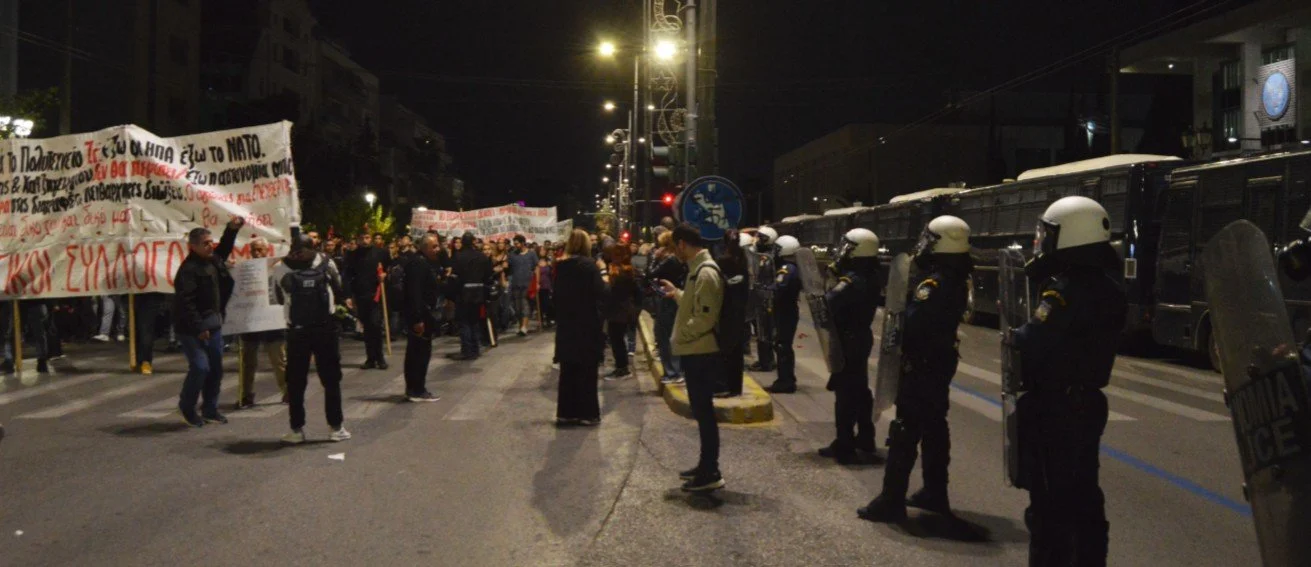
ATHENS— The air was already heavy on Alexandras Avenue by early evening, long before the march reached the U.S. Embassy. What starts every year as a commemoration of the 1973 Polytechnic uprising has become something more layered: a test of political mood, a measure of how Greece sees its alliances, and a glimpse into which way the city’s younger blocs are leaning.More than an hour before the front banners arrived, riot police units took up positions along the perimeter streets leading to the embassy.They stood with the practiced stillness of a force that has done this dozens of times, knowing that the march always stops here, and that everything after depends on the mood of the crowd.By the time the first clusters of protesters reached the avenue, the crowd had thickened into thousands. Older men who lived through past marches walked alongside students who weren’t born when the first antiauthoritarian blocs took shape. Metal barricades rattled under the weight of people leaning over them for a clearer view.The march moved in formations, not as a loose flow but as coordinated blocs. The most striking among them was a disciplined, almost paramilitary student contingent: black shirts, helmets clipped to their belts, thick wooden sticks wrapped with red flags These blocs act as their own internal security, a hallmark of Greek protest culture. They’re loud, sharp, and disciplined, exactly the opposite of how protests look in much of the world. When they move, they move as one.A few meters ahead of them, the lead banners stretched across the width of the 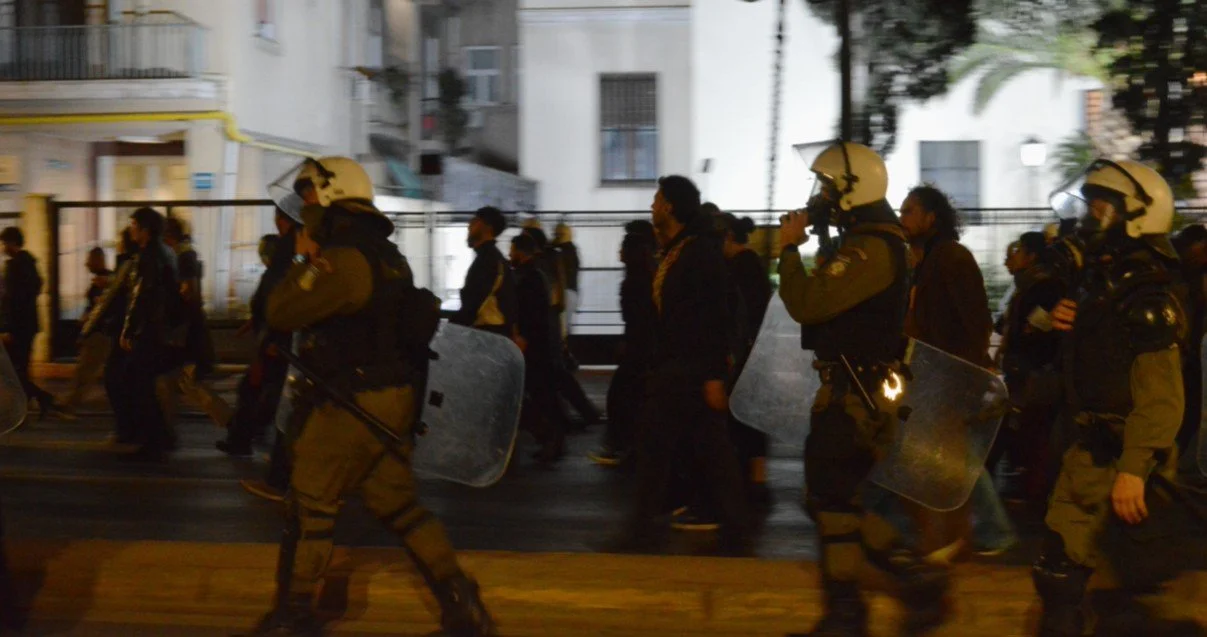
MAT Police hurry to a call at the front of the protest, gas masks on
Greek police guard the front of the U.S Embassy, Alexandras Avenue
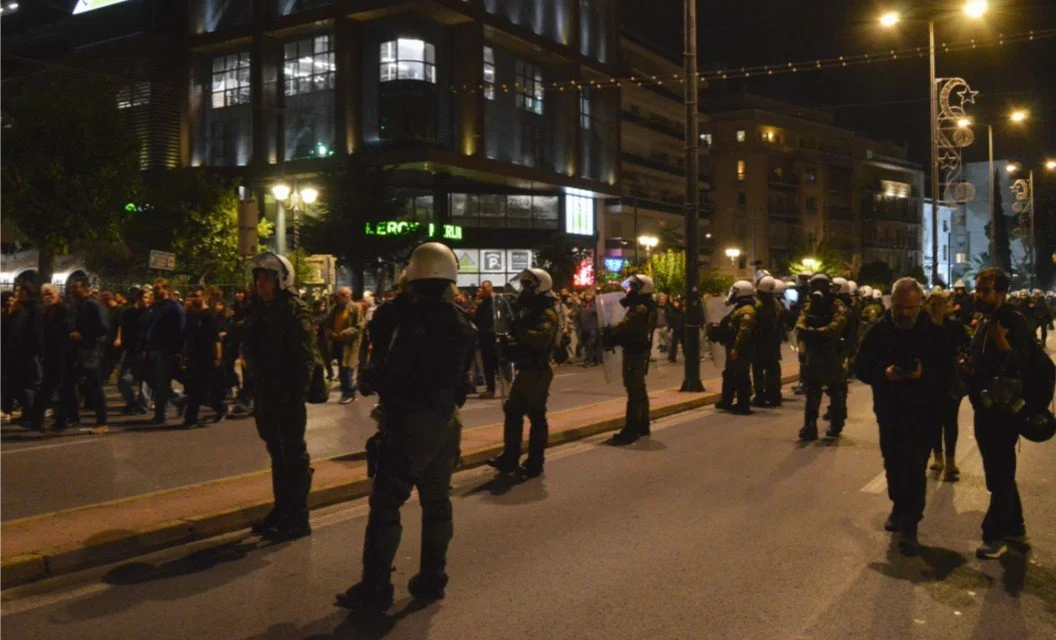
MAT Police walk next to protesters, ready to create a defensive barrier in a moment’s notice
What stood out this year wasn’t violence -there was none in the areas I covered- but choreography. The flow of people, the measured retreat of police lines as the march advanced, the unspoken rules between blocs and officers who have learned to read one another’s posture.Side streets filled with families watching from a distance. Some cheered; others filmed; others simply stood with hands in pockets, taking in the spectacle as if it were a ritual, which, by now, it is.Further behind the main blocs, the scene took on a different rhythm: marchers singing, small groups joking with one another, police walking in parallel By the time the last groups passed the embassy perimeter, the city had quieted. Only the blinking sirens and the fading chants lingered over the avenue. For a brief stretch, Athens felt suspended - a city reenacting its past while trying to assert its present.The November 17 march is always about memory. But after watching it up close, it’s also clear that it’s about measurement, of power, of solidarity, of who still shows up and why. And like most political rituals, the real story is in who stands in the street when the lights hit them.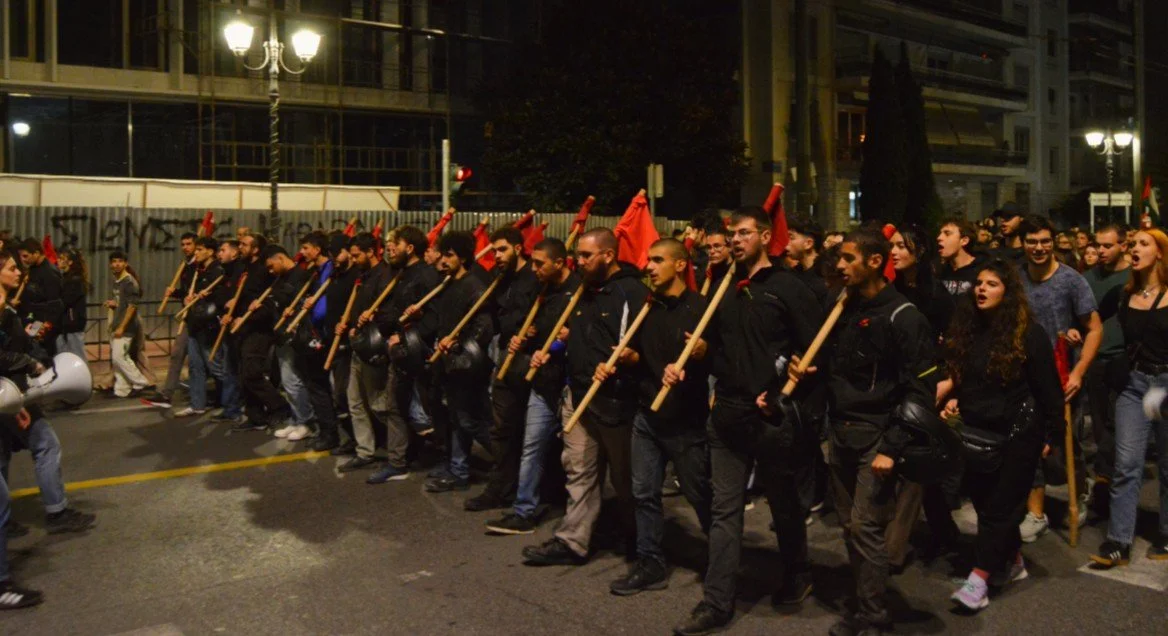
A tightly organized leftist student bloc marches in formation toward the police line.